Origin of life: Who accepts which explanations?
Updated 1 October 2026
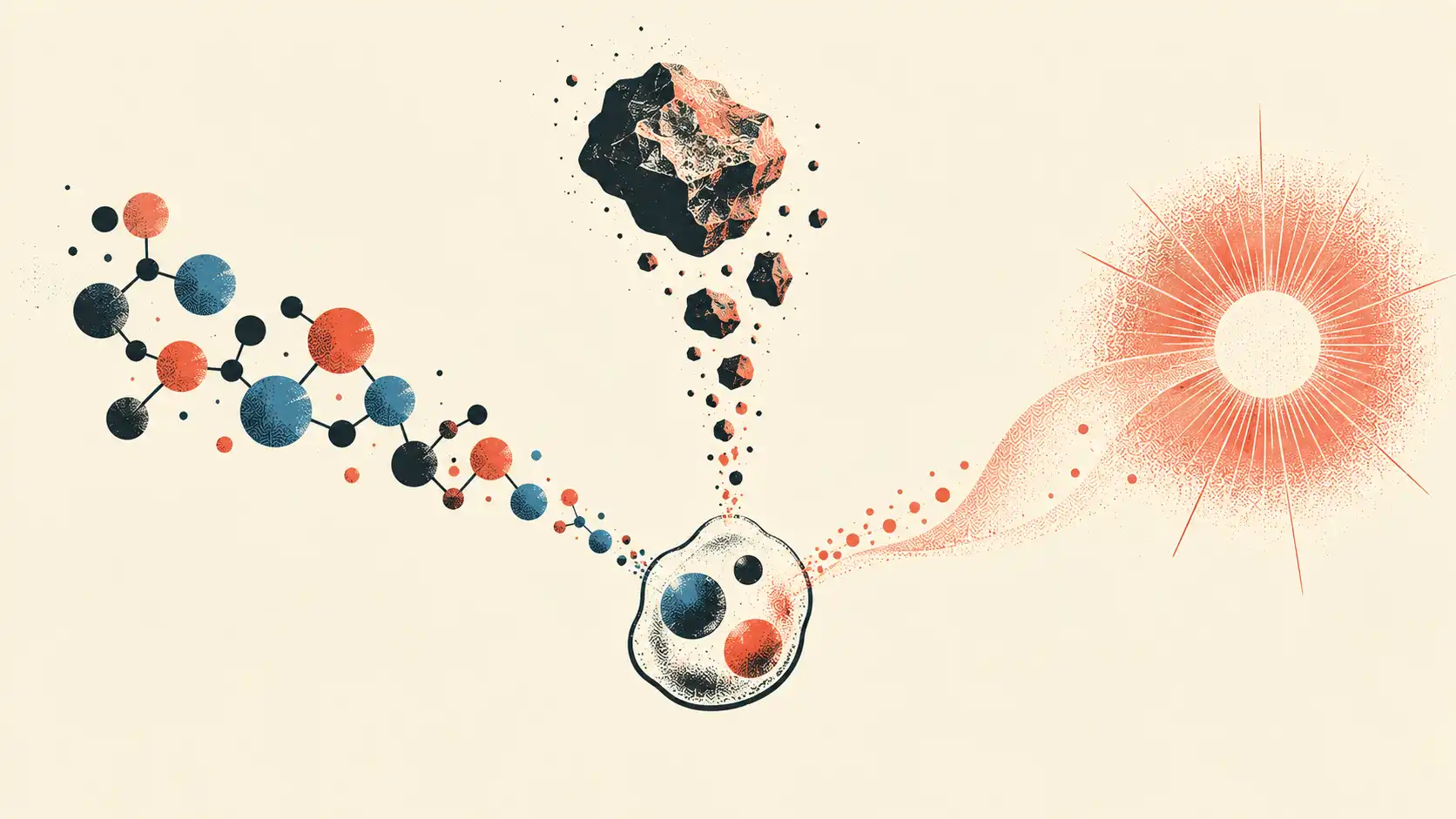
Jack W. Szostak · Terrestrial abiogenesis
Szostak describes early-Earth surface chemistry in impact-crater and volcanic settings as producing key building blocks, with fatty-acid membranes self-assembling into primitive compartments.
Jack W. Szostak · RNA-first
His 2025 lecture explicitly centers the RNA World hypothesis and asks how prebiotic Earth chemistry could generate RNA that became part of the first primordial cells.
Now we just needed to figure out how to get RNA from nothing
Nick Lane · Terrestrial abiogenesis
Lane's work links alkaline hydrothermal geochemistry, carbon fixation, protocells and selection into a continuous terrestrial route from non-life toward cells.
Nick Lane · RNA-first
Lane's framework allows genes and proteins to emerge from a pre-existing protometabolic network; that is incompatible with RNA or genetic replication being the primary initiating stage in the exact sense defined here.
before the emergence of genes
Nick Lane · Metabolism-first
The model starts with hydrothermal energy gradients, carbon fixation and self-organizing protocells, producing metabolic heredity before fully developed genetic heredity.
giving a metabolic heredity that promotes growth
Nick Lane · Coupled systems
Lane describes a continuum in which geochemistry generates protocells, metabolic heredity enables selection, and genetic information emerges within that system rather than from an isolated molecule.
Nick Lane · Panspermia
Lane has explicitly said there is no evidence that intact life arrived from elsewhere and that panspermia merely relocates the unanswered origin problem; his current research continues to develop a terrestrial hydrothermal model.
it just moves the problem somewhere else
John D. Sutherland · Terrestrial abiogenesis
Sutherland's current account works upward from geochemically plausible chemistry, including hydrogen-cyanide networks that can generate nucleotide, amino-acid and lipid precursors.
John D. Sutherland · RNA-first
Sutherland studies nucleotide chemistry and RNA-related pathways, while explicitly arguing against focusing solely on genetics and emphasizing co-evolution with other chemical subsystems.
John D. Sutherland · Metabolism-first
His holistic strategy treats metabolism as one interacting dimension alongside genetics and compartmentalization rather than documenting a simple metabolism-first ordering.
John D. Sutherland · Coupled systems
Sutherland explicitly combines 'biology down' and 'chemistry up' and stresses interconnected chemical innovations rather than isolated origin scenarios.
more than isolated experiments
Sara Imari Walker · Coupled systems
Walker's 2026 assembly-theory essay seeks physical measures for the transition from non-life to life and explicitly aims to bridge the traditional divide between metabolism-first and genetics-first scenarios.
cascade of major transitions in molecular order
Gary Ruvkun · Terrestrial abiogenesis
In a 2025 Nobel Prize conversation, Ruvkun directly agrees that the tree of life makes him suspect terrestrial life originated elsewhere and then identifies his view as panspermia.
Gary Ruvkun · Panspermia
Ruvkun says he suspects life did not originate on Earth and argues that interplanetary spread is a serious possibility worth testing through searches for shared genetic signatures.
It's panspermia
Richard Dawkins · Terrestrial abiogenesis
Dawkins says the origin remains unresolved in detail but describes the relevant event as chemistry giving rise to a self-replicating molecule on the early Earth.
Something the laws of chemistry gave rise to a molecule
Richard Dawkins · RNA-first
Dawkins says the first replicator was almost certainly not DNA and required a precursor; the cited statement is not specific enough to classify him as endorsing or rejecting RNA-first.
There had to be a precursor to DNA.
Richard Dawkins · Divine / intelligent agency
When directly asked whether the first replicating structure might be the work of God, Dawkins argues that adding God is explanatorily superfluous. His later public statements continue to reject belief in God for lack of evidence.
It's a superfluous part of the explanation.
Stephen C. Meyer · Terrestrial abiogenesis
Meyer argues that chance and self-organization do not adequately explain life's digital information and presents intelligence, rather than a purely physical-chemical origin, as the better causal explanation.
not blind processes, but intelligence
Stephen C. Meyer · Divine / intelligent agency
Meyer explicitly presents intelligent design as the best explanation for life's digital code and, in his broader current argument, connects design evidence to a Creator.
BioLogos · Terrestrial abiogenesis
BioLogos says God could have created the first life through regular processes or through a miracle. It therefore allows terrestrial abiogenesis without claiming that a particular natural pathway is established.
God could have created the first life through regular processes
BioLogos · RNA-first
BioLogos explains the gene-first/RNA hypothesis but says both gene-first and metabolism-first accounts lack conclusive evidence, so its institutional position is not a clear endorsement or rejection.
BioLogos · Metabolism-first
BioLogos presents metabolism-first alongside gene-first/RNA accounts and explicitly says neither has conclusive evidence, leaving its position on the exact proposition unresolved.
BioLogos · Panspermia
BioLogos notes the possibility that life came from another planet but says this only moves the origin problem elsewhere and does not provide a compelling scientific explanation of life's first origin.
only pushes the question farther back
BioLogos · Divine / intelligent agency
BioLogos explicitly affirms divine creation and sustenance of life, while allowing either regular natural processes or a miracle as the proximate means.
God is the creator and sustainer of all life
Sources
- Cornell Chronicle — Nobel laureate shares research exploring the origins of life ·
- PLOS Biology — Selection for growth drives the emergence of genetic heredity in protocells ·
- Annual Review of Ecology, Evolution, and Systematics — Life as a Guide to Its Own Origins ·
- The Naked Scientists — What is life and where did it come from? ·
- ETH Zurich Centre for Origin and Prevalence of Life — Exploring the Origins of Life: A Holistic Perspective ·
- arXiv — Metrology of Complexity and Implications for the Study of the Emergence of Life ·
- Nobel Prize Outreach — Gary Ruvkun: Nobel Prize Conversations ·
- Piers Morgan Uncensored — Piers Morgan Uncensored: Richard Dawkins Exclusive ·
- Reasonable Faith — Interview with Richard Dawkins ·
- PBS — Interview: Richard Dawkins ·
- Freakonomics — Richard Dawkins on God, Genes, and Murderous Baby Cuckoos ·
- Stephen C. Meyer — Can Chance Explain the Origin of Life? Stephen Meyer Responds ·
- Discovery Institute — Dr. Stephen Meyer Answers the Biggest Questions About God & Science ·
- BioLogos — How Did Life Begin? ·
More
No debates have been published in this category yet.
View allNo debates have been published in this category yet.
View allNo debates have been published in this category yet.
View allNo debates have been published in this category yet.
View allNo debates have been published in this category yet.
View allNo debates have been published in this category yet.
View all